
Discuss the politics of style and the reconfiguration of cultural material via a screen example.
In the past few decades, there has been a remarkable evolution in the television industry, “an era of narrative experimentation and innovation, challenging the norms of what the medium can do” (Mittell, 2006:29). The Wire, created and primarily overseen by David Simon, a former police reporter, is a drama serial dealing with the crippling situation in the major US city of Baltimore, primarily the drug trade and its impact on surrounding citizens and institutions. It is a quintessential example of a series that harnesses the narrative possibilities of television, exhibiting a marriage between subject and medium that pushes an agenda. I will interpret “the politics of style” as the reasons and motivations behind why certain styles are employed, particularly in relation to its subject matter. The “reconfiguration of cultural material,” meanwhile, is the process of certain cultural norms and artefacts being manipulated and ‘defamiliarised’ for similar reasons, political or otherwise. I will justify the existence of such politics and reconfigurations, largely resultant of a continuing evolution, both stylistically and mechanically, in the serial narrative, and also the technological elements make this evolution possible.

The series has an intense relationship with reality, being almost documentarian in its realism and accuracy. Many of the characters are fictionalised versions of real-life Baltimorean figures; detectives, politicians, criminals and journalists (Simon, 2005). The function of the show extends beyond being a pure form of entertainment, using the basis of reality in the framework of realism to confront the viewer about the situation in Baltimore City. It requires a form of storytelling possible only in a televisual medium, “the more serialized the textual structure, the greater the opportunities for multiple plot chains” (Harriss, 2008:57). Because of the diverse range of Baltimorean institutions that are all contributing to the same decline of the city, The Wire takes an ambitious approach by depicting the stories from many perspectives. The parallels between all the institutions within the city point towards fundamental failings that puts the whole city in disrepair.

One of the major problems in Baltimore is a common, corrupt desire by institutions to cut corners; as Ed Burns, co-creator and a head writer of The Wire, states, “it's all driven by the concept of numbers” (Balko, 2008:52). This is particularly true in the police department, where statistics such as 'clearance rate' (percentage of cases solved), become the make-or-break quota for promotions of officers and elections of public officials. The incentives to drive these 'numbers' up by deceptive, often ineffective means is referred to as ‘juking the stats,’ and has managed to penetrate most of city’s institutions in different forms. While the police department remains a scrutinised environment throughout on The Wire, a new institution is addressed every season. In the fourth season ('Know Your Place', 4x09), the public school system sacrifices certain curricula in favour of increasing the scores meaningless standardised tests, analogous to meaningless arrests by police officers. In the fifth season, the focus is on journalism, and again we witness the same pattern, with the character of Baltimore Sun reporter Templeton resorting to fabricating headlining stories ('React Quotes', 5x05) in a desperate attempt at recognition. Walker points out that “impact means prize”, which gives rise to a “prize-hungry journalism [that is] a substitute for the real thing” (2008:55).
The advantage of a broad, complex, multiple perspective narrative, as in the case of The Wire, is that the parallels running between supposedly isolated institutions are pronounced. Such uniting characteristics of a single city could in fact be why critics have said “the city of Baltimore is really the central character in The Wire” (Balko, 2008:51). Multiple perspectives provide devices such as juxtaposition and contrast that are crucial to the content of The Wire. What is more effective than merely portraying the poorer classes in disturbing, adverse situations is to have them in contrast with the failing bureaucratic systems surrounding them. This comparison emphasises the show’s common theme of hierarchy; both in the nature of the city’s isolation between its social classes and also the hierarchies in its institutions, and the subversion of these structures.
In reality, the two institutions that are the leading causes for polarising the classes in Baltimore are the police department and the media. Burns has mentioned the “militarisation” of the police department, “racking up numbers” (arrest statistics) by means of petty, ineffective arrests, “alienating the police department from the community” and turning them into “an army of occupation” (Balko, 2008:52). Burns also takes issue with the term ‘war on drugs,’ saying that “they’re not warring on drugs... they’re warring on drug addicts… on neighborhoods… on people who can’t stand up to them,” as opposed to the major dealers, the “big stakeholders” and kingpins (Balko, 2008:49). Walker adds that the manner by which The Baltimore Sun covers the city, “especially, but not exclusively, the blacker, poorer parts of Baltimore” is written as though it were “an alien landscape” (2008:56).

Despite the lack of explicit monetary values or connections to capital, the idea that of inflating a statistics (the quality of which contradicts the magnitudes of the statistics themselves) can be seen as a capitalistic desire. This is especially true since the statistics do lead to rewards and remuneration, in the form of promotions and elected offices, which unsurprisingly are associated with power and the ascension in the hierarchies. In this way, the desire by these institutions to float meaningless statistics feeds into capitalism and results in isolating effects. The Wire, by presenting its stories in a multiple perspective, linear structure, emphasises the causal effects of the actions by the institutions on Baltimore's poorer class, strengthening its commentary on the city and also on capitalism.
Hierarchies can be seen in both the law enforcement authorities and the criminal organisations. The following are screenshots of character charts from the official site for The Wire, and we see the similar chains-of-command in both “the law” and on “the street”.


Burns has mentioned how heroin gangs have based their organisational structures on the 1972 film, The Godfather, how it
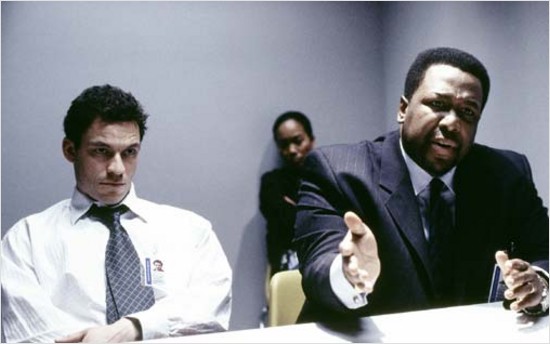
It is extremely difficult to pigeonhole The Wire into a single genre, but one certain genre that could be appropriately applied is the police procedural. However, much like the evolving, boundary-pushing nature of the show itself, The Wire’s adherence to this genre is conditional and even circumstantial. I will first establish the grounds of police procedural before detailing its relation to The Wire. In Harriss’s article, he breaks down the police procedural genre using Propp’s method for analysing Russian folktales and Bordwell’s functions of the detective film (2008:43). In Harriss’s examination (which I summarise here), he highlights through Bordwell that “detective films [using] the procedural structure typically contain two distinct segments: the crime (commission, concealment, discovery) and the investigation (awareness, investigation, elucidation, and identification)” (2008: 46).
The Wire itself follows these schematics quite faithfully and entirely. All these stages of the procedure are used, varying in their time-spans from the first stage (commission of the crime) to the last stage, if it is reached (elucidation of case and identification of perpetrator). Some cases get resolved within the episode; in “All Due Respect” (3x02), a misguided wiretap into the belief that Cheese had confessed to committing murder when the victim turned out to be a dog. Some cases get solved within a season, such as the homicide of thirteen Jane Does in a shipping container from the second season. Others are not resolved (do not reach the final stage of elucidation and identification) until subsequent seasons, such as the Stanfield’s organisation’s bodies in the vacant housing lots which spanned through the fourth and fifth seasons.

The major deviation here is that rather than confining the episodes to the span of the case, which is how most procedurals such as Law & Order and CSI are structured, the case time spans on The Wire are not manipulated to fit a certain allocated time frame. This adds to the show’s endeavour for a realistic and naturalistic character, as real life cases do not all resolve themselves in the same amount of time. As Harriss states, these instances of deviation from a given formula in a show such as The Wire are not completely unexpected; “Propp was not blind to the potential for generic changes over time,” but merely felt that “the structure needed a solid, static definition before these changes could be accurately observed” (Harriss, 2008:44). Wright has also illustrated that “structural shifts are likely to occur within a genre as time passes” (1975). The Wire is still fundamentally a police procedural, as it is still the de facto prominent theme running throughout the series, and all the auxiliary environments and perspectives from other parts of the city do not detract from this fact.
The whole angle taken by David Simon when he pitched the idea of The Wire in a letter to HBO was to create a series “grounded in the most basic network universe—the cop show,” but moreso than the “significant victory for HBO to counterprogram alternative, inaccessible worlds,” it would be daring for “taking… worlds [of network television] and transforming them with honesty and wit and a darker, cynical, and more piercing viewpoint than they would ever undertake” (2004:39). This can be attributed to the notion of ‘defamiliarisation’:
In fact, the serialisation component of The Wire is quite overstated, to the point where the seasons and even the entire series feel like visual novels. The identification of a resemblance between serial and novel is not new, McGrath likened television seriality of narrative complexity to that of a progression of a novel, referred to as “novelistic” television (2000). David Simon has himself referred to The Wire as a “visual novel” (2004:25):
The Wire’s incredibly slow pace (something that both the viewers and creators pride themselves on is the required patience associated with the show) is often criticised; the Michigan Daily saying that even “those who eventually turn themselves over to the season-long storyline will be put off at first” (2002). Coupled with its highly serialised, complex plot, the series is very difficult to follow for those who begin from any other point that's not the very beginning. In terms of televisual programming, this is an enormous risk considering viewership based on those who started from the beginning would be few, and the lack of 'in-points' would do little to pick up new viewers. How did it then end up lasting five healthy seasons?
With dramatic shifts in the technological component of the television industry, “networks and channels have grown to recognize that a consistent cult following of a small but dedicated audience can suffice to make a show economically viable” (Mittell, 2006:31). In the past, only highly rated shows were feasible to continue making. However, poor ratings did not necessarily reflect the quality of the show, much like the high arrest statistics in Baltimore did not accurately reflect the quality of the police work. Some short-lived programs suffered unfortunate circumstances in programming air time; this was became retrospectively clear with short-lived series such as Firefly and Freaks and Geeks when they went on to become successful as DVD releases (Mittell, 2006:31).

DVD technology has had an enormous impact on the television industry, providing an outlet for pre-existing short-lived programs to continue existing, and also fostering aesthetic and narrative experimentation. It has also encouraged networks to “capitalize upon [it] by creating programs with maximum ‘rewatchability’” (Mittell, 2006:31). The Wire is a highly rewatchable show purely because it is so complex; the intricate plot allusions and subtle details make it difficult to fully comprehend in a single, scheduled sitting. However, The Wire completely disregards narrative devices designed to make the plot more accessible such as analpses (flashbacks) and voice-over narration, mainly because these artificial devices detract from the realism the show is committed to emulating. DVD technology has been the compromise, the DVD box set phenomenon described by Kompare as a “landmark of media design, successfully formatting an established brand into a new configuration” (2006:348). This compromise has allowed audiences fuller appreciation of the narrative through multiple viewings, while allowing the creators to stay truer to their original artistic intention (The Wire’s realism being one of its crucial elements). It also gives the networks an incentive to allow more artistic freedom since there is a lucrative margin in DVD sales.
The Wire is an illustration of style being dictated by subject instead of medium. Rather than pander to the limitations of a typical distracted television audience, it pushes its own agenda of addressing the deterioration of a city with a narrative style utilising, without reservation, complexity and realism in lieu of convention and accessibility. The Wire is a form of programming which is a kind of “cognitive workout,” with “storytelling that encourages audiences to become more actively engaged" and "offers a broader range of rewards and pleasures than most conventional programming” (Johnson, 2005). As well as reconfiguring the cultural notion of television, The Wire also reconfigures genre, specifically the police procedural that has grown into a regular cultural fixture on network television, by means of its use in the context of social commentary rather than sheer entertainment.
Filmography
The Wire (2002-2008) HBO
—‘Old Cases’ Ep. 1x04. 23 Jun. 2002
—‘Collateral Damage’ Ep. 2x02. 8 Jun. 2003
—‘All Due Respect’ Ep. 3x02. 26 Sept. 2004
—‘Boys of Summer’ Ep. 4x01 Sept, 2006
—‘Know Your Place’ Ep. 4x09. 12 Nov. 2006
—‘A New Day’ Ep. 4x11. 26 Nov. 2006
—‘React Quotes’ Ep. 5x05. 3 Feb. 2008
Law & Order (1990- ) NBC
NYPD Blue (1993-2005) ABC
CSI: Crime Scene Investigation (2000- ) CBS
Freak and Geeks (1999-2000) NBC
Firefly (2002-2003) FOX
The Godfather (1973) dir. Francis Ford Coppola, Paramount
References
—Balko, R. (2008) ‘30 Years of Failure’, Reason, 40(2) pp. 48-54
—Bordwell, D. (1985) Narration in the Fiction Film. Madison: University of Wisconsin Press
—Harriss, C. (2008) ‘Policing Propp: Toward a Textualist Defintion of the Procedural Drama’ ,Journal of Film and Video, 60(1):43-59
—Johnson, S. (2005) Everything Bad Is Good for You: How Today’s Popular Culture Is Actually Making Us Smarter. New York: Riverhead Books
—Kompare, D. (2006) ‘Publishing Flow: DVD Box Sets and the Reconception of Television’, Television & New Media, 7(4): 335-360
—McGrath, C. (2000) ‘The Triumph of the Prime-Time Novel.’ In H. Newcomb (ed.) Television: The Critical View. 6th ed. New York: Oxford University Press, pp. 242-52
—Mittell, J. (2004) Genre and Television: From Cop Shows to Cartoons in American Culture. New York: Routledge
—Mittell, J. (2006) ‘Narrative Complexity in Contemporary American Television’, The Velvet Light Trap, 58:29-40
—Propp, V. (1968) Morphology of the Folktale, Trans. Laurence Scott, 2nd ed. Austin: Unviersity of Texas Press
—Simon, D. (2004) ‘Introduction by David Simon’ in R. Alvarez, The Wire: Truth Be Told. New York: Pocket Books, pp. 2-34
—Simon, D. (2004) ‘Letter to HBO’ in R. Alvarez, The Wire: Truth Be Told. New York: Pocket Books, pp. 35-39
—Walker, J. (2008) ‘The Wire vs. The Sun,’ Reason, 40(2) pp. 54-57
—Wieser, T. (2002) ‘New HBO series ‘The Wire’ taps into summer programming,’ The Michigan Daily, 17 June [link]
—Wright, W. (1975) Sixguns and Society: A Structural Study of the Western. Berkley: University of California Press
In the past few decades, there has been a remarkable evolution in the television industry, “an era of narrative experimentation and innovation, challenging the norms of what the medium can do” (Mittell, 2006:29). The Wire, created and primarily overseen by David Simon, a former police reporter, is a drama serial dealing with the crippling situation in the major US city of Baltimore, primarily the drug trade and its impact on surrounding citizens and institutions. It is a quintessential example of a series that harnesses the narrative possibilities of television, exhibiting a marriage between subject and medium that pushes an agenda. I will interpret “the politics of style” as the reasons and motivations behind why certain styles are employed, particularly in relation to its subject matter. The “reconfiguration of cultural material,” meanwhile, is the process of certain cultural norms and artefacts being manipulated and ‘defamiliarised’ for similar reasons, political or otherwise. I will justify the existence of such politics and reconfigurations, largely resultant of a continuing evolution, both stylistically and mechanically, in the serial narrative, and also the technological elements make this evolution possible.

The series has an intense relationship with reality, being almost documentarian in its realism and accuracy. Many of the characters are fictionalised versions of real-life Baltimorean figures; detectives, politicians, criminals and journalists (Simon, 2005). The function of the show extends beyond being a pure form of entertainment, using the basis of reality in the framework of realism to confront the viewer about the situation in Baltimore City. It requires a form of storytelling possible only in a televisual medium, “the more serialized the textual structure, the greater the opportunities for multiple plot chains” (Harriss, 2008:57). Because of the diverse range of Baltimorean institutions that are all contributing to the same decline of the city, The Wire takes an ambitious approach by depicting the stories from many perspectives. The parallels between all the institutions within the city point towards fundamental failings that puts the whole city in disrepair.

One of the major problems in Baltimore is a common, corrupt desire by institutions to cut corners; as Ed Burns, co-creator and a head writer of The Wire, states, “it's all driven by the concept of numbers” (Balko, 2008:52). This is particularly true in the police department, where statistics such as 'clearance rate' (percentage of cases solved), become the make-or-break quota for promotions of officers and elections of public officials. The incentives to drive these 'numbers' up by deceptive, often ineffective means is referred to as ‘juking the stats,’ and has managed to penetrate most of city’s institutions in different forms. While the police department remains a scrutinised environment throughout on The Wire, a new institution is addressed every season. In the fourth season ('Know Your Place', 4x09), the public school system sacrifices certain curricula in favour of increasing the scores meaningless standardised tests, analogous to meaningless arrests by police officers. In the fifth season, the focus is on journalism, and again we witness the same pattern, with the character of Baltimore Sun reporter Templeton resorting to fabricating headlining stories ('React Quotes', 5x05) in a desperate attempt at recognition. Walker points out that “impact means prize”, which gives rise to a “prize-hungry journalism [that is] a substitute for the real thing” (2008:55).

The advantage of a broad, complex, multiple perspective narrative, as in the case of The Wire, is that the parallels running between supposedly isolated institutions are pronounced. Such uniting characteristics of a single city could in fact be why critics have said “the city of Baltimore is really the central character in The Wire” (Balko, 2008:51). Multiple perspectives provide devices such as juxtaposition and contrast that are crucial to the content of The Wire. What is more effective than merely portraying the poorer classes in disturbing, adverse situations is to have them in contrast with the failing bureaucratic systems surrounding them. This comparison emphasises the show’s common theme of hierarchy; both in the nature of the city’s isolation between its social classes and also the hierarchies in its institutions, and the subversion of these structures.
In reality, the two institutions that are the leading causes for polarising the classes in Baltimore are the police department and the media. Burns has mentioned the “militarisation” of the police department, “racking up numbers” (arrest statistics) by means of petty, ineffective arrests, “alienating the police department from the community” and turning them into “an army of occupation” (Balko, 2008:52). Burns also takes issue with the term ‘war on drugs,’ saying that “they’re not warring on drugs... they’re warring on drug addicts… on neighborhoods… on people who can’t stand up to them,” as opposed to the major dealers, the “big stakeholders” and kingpins (Balko, 2008:49). Walker adds that the manner by which The Baltimore Sun covers the city, “especially, but not exclusively, the blacker, poorer parts of Baltimore” is written as though it were “an alien landscape” (2008:56).

Despite the lack of explicit monetary values or connections to capital, the idea that of inflating a statistics (the quality of which contradicts the magnitudes of the statistics themselves) can be seen as a capitalistic desire. This is especially true since the statistics do lead to rewards and remuneration, in the form of promotions and elected offices, which unsurprisingly are associated with power and the ascension in the hierarchies. In this way, the desire by these institutions to float meaningless statistics feeds into capitalism and results in isolating effects. The Wire, by presenting its stories in a multiple perspective, linear structure, emphasises the causal effects of the actions by the institutions on Baltimore's poorer class, strengthening its commentary on the city and also on capitalism.
Hierarchies can be seen in both the law enforcement authorities and the criminal organisations. The following are screenshots of character charts from the official site for The Wire, and we see the similar chains-of-command in both “the law” and on “the street”.


Source: HBO
Burns has mentioned how heroin gangs have based their organisational structures on the 1972 film, The Godfather, how it
basically taught these emerging heroin gangs how to do business, how you set up your structure, with the code and the organization, the way you should have a boss, under-bosses-you know, capos. It got black, inner-city heroin dealers into the same mind-set (Balko, 2008:52).Regardless of the origins of the hierarchical structures, this diagrammatic parallel between the two opposing, belligerent institutions further emphasises the commonality and fundamental nature of the failings in Baltimore. The Wire is able to use narrative devices such as multiple perspectives to highlight these juxtapositions and effect an accurate reflection of this society.
It is extremely difficult to pigeonhole The Wire into a single genre, but one certain genre that could be appropriately applied is the police procedural. However, much like the evolving, boundary-pushing nature of the show itself, The Wire’s adherence to this genre is conditional and even circumstantial. I will first establish the grounds of police procedural before detailing its relation to The Wire. In Harriss’s article, he breaks down the police procedural genre using Propp’s method for analysing Russian folktales and Bordwell’s functions of the detective film (2008:43). In Harriss’s examination (which I summarise here), he highlights through Bordwell that “detective films [using] the procedural structure typically contain two distinct segments: the crime (commission, concealment, discovery) and the investigation (awareness, investigation, elucidation, and identification)” (2008: 46).
An interesting investigative scene from The Wire, episode 'Old Cases' (1x04), where the word "fuck" and its variants are the only form of communication between the two homicide detectives.
The Wire itself follows these schematics quite faithfully and entirely. All these stages of the procedure are used, varying in their time-spans from the first stage (commission of the crime) to the last stage, if it is reached (elucidation of case and identification of perpetrator). Some cases get resolved within the episode; in “All Due Respect” (3x02), a misguided wiretap into the belief that Cheese had confessed to committing murder when the victim turned out to be a dog. Some cases get solved within a season, such as the homicide of thirteen Jane Does in a shipping container from the second season. Others are not resolved (do not reach the final stage of elucidation and identification) until subsequent seasons, such as the Stanfield’s organisation’s bodies in the vacant housing lots which spanned through the fourth and fifth seasons.
The major deviation here is that rather than confining the episodes to the span of the case, which is how most procedurals such as Law & Order and CSI are structured, the case time spans on The Wire are not manipulated to fit a certain allocated time frame. This adds to the show’s endeavour for a realistic and naturalistic character, as real life cases do not all resolve themselves in the same amount of time. As Harriss states, these instances of deviation from a given formula in a show such as The Wire are not completely unexpected; “Propp was not blind to the potential for generic changes over time,” but merely felt that “the structure needed a solid, static definition before these changes could be accurately observed” (Harriss, 2008:44). Wright has also illustrated that “structural shifts are likely to occur within a genre as time passes” (1975). The Wire is still fundamentally a police procedural, as it is still the de facto prominent theme running throughout the series, and all the auxiliary environments and perspectives from other parts of the city do not detract from this fact.
The whole angle taken by David Simon when he pitched the idea of The Wire in a letter to HBO was to create a series “grounded in the most basic network universe—the cop show,” but moreso than the “significant victory for HBO to counterprogram alternative, inaccessible worlds,” it would be daring for “taking… worlds [of network television] and transforming them with honesty and wit and a darker, cynical, and more piercing viewpoint than they would ever undertake” (2004:39). This can be attributed to the notion of ‘defamiliarisation’:
[S]tylistic changes to a formulaic narrative structure have the capacity to make the formula appear new, strange—in a word, to defamiliarize it, to borrow yet another term from Russian formalism… Through defamiliarization, artistic works… take common, familiar objects, texts, and concepts, and make them appear new. (Harriss, 2008:57)The Wire does truly take one of the most tattered television genres and completely defamiliarises it in several ways. While traditional procedurals only present the police perspective, The Wire offers equal representation of all sides of the law, including authority figures outside the police department (city hall) and other neutralised institutions (the docks, the school, the media). Traditional procedurals are confined to the censorship of network television, whereas The Wire stays faithful to the society it explores with brutally honest depictions of graphic violence, excessive profanity and sex. Finally, as mentioned earlier, traditional procedurals tend be episodically self-contained with cases, and those which do serialise elements such as NYPD Blue rarely do so with the subject of the procedural itself (the police work) but rather things like relationships and personal lives.
In fact, the serialisation component of The Wire is quite overstated, to the point where the seasons and even the entire series feel like visual novels. The identification of a resemblance between serial and novel is not new, McGrath likened television seriality of narrative complexity to that of a progression of a novel, referred to as “novelistic” television (2000). David Simon has himself referred to The Wire as a “visual novel” (2004:25):
To the same end, in a series of press interviews, I began referring to the work as a ‘visual novel,’ explaining that the first episodes of the show had to be considered much as the first chapters of any book of even moderate length… “Think about the first few chapters of any novel you ever liked, say, Moby-Dick,” I told one reporter in a phone interview. “In the first couple of chapters, you don’t meet the whale, you don’t meet Ahab, you don’t even go abroad the Pequod. All that happens is you go with Ishmael to the inn and fin doubt he has to share a room with some tattooed character. Same thing here. It’s a visual novel.”As stated, the slowly evolving nature of the cases and intermingling plotlines on The Wire contain far too many subtle nuances and details for a film format. The meticulous and patiently unfolding subject matter suits “the broader challenges and possibilities for creativity in long-form series, as extended character depth, ongoing plotting, and episodic variations are simply unavailable options within a two-hour film” (Mittell, 2006:31).
The Wire’s incredibly slow pace (something that both the viewers and creators pride themselves on is the required patience associated with the show) is often criticised; the Michigan Daily saying that even “those who eventually turn themselves over to the season-long storyline will be put off at first” (2002). Coupled with its highly serialised, complex plot, the series is very difficult to follow for those who begin from any other point that's not the very beginning. In terms of televisual programming, this is an enormous risk considering viewership based on those who started from the beginning would be few, and the lack of 'in-points' would do little to pick up new viewers. How did it then end up lasting five healthy seasons?
With dramatic shifts in the technological component of the television industry, “networks and channels have grown to recognize that a consistent cult following of a small but dedicated audience can suffice to make a show economically viable” (Mittell, 2006:31). In the past, only highly rated shows were feasible to continue making. However, poor ratings did not necessarily reflect the quality of the show, much like the high arrest statistics in Baltimore did not accurately reflect the quality of the police work. Some short-lived programs suffered unfortunate circumstances in programming air time; this was became retrospectively clear with short-lived series such as Firefly and Freaks and Geeks when they went on to become successful as DVD releases (Mittell, 2006:31).

DVD technology has had an enormous impact on the television industry, providing an outlet for pre-existing short-lived programs to continue existing, and also fostering aesthetic and narrative experimentation. It has also encouraged networks to “capitalize upon [it] by creating programs with maximum ‘rewatchability’” (Mittell, 2006:31). The Wire is a highly rewatchable show purely because it is so complex; the intricate plot allusions and subtle details make it difficult to fully comprehend in a single, scheduled sitting. However, The Wire completely disregards narrative devices designed to make the plot more accessible such as analpses (flashbacks) and voice-over narration, mainly because these artificial devices detract from the realism the show is committed to emulating. DVD technology has been the compromise, the DVD box set phenomenon described by Kompare as a “landmark of media design, successfully formatting an established brand into a new configuration” (2006:348). This compromise has allowed audiences fuller appreciation of the narrative through multiple viewings, while allowing the creators to stay truer to their original artistic intention (The Wire’s realism being one of its crucial elements). It also gives the networks an incentive to allow more artistic freedom since there is a lucrative margin in DVD sales.
The Wire is an illustration of style being dictated by subject instead of medium. Rather than pander to the limitations of a typical distracted television audience, it pushes its own agenda of addressing the deterioration of a city with a narrative style utilising, without reservation, complexity and realism in lieu of convention and accessibility. The Wire is a form of programming which is a kind of “cognitive workout,” with “storytelling that encourages audiences to become more actively engaged" and "offers a broader range of rewards and pleasures than most conventional programming” (Johnson, 2005). As well as reconfiguring the cultural notion of television, The Wire also reconfigures genre, specifically the police procedural that has grown into a regular cultural fixture on network television, by means of its use in the context of social commentary rather than sheer entertainment.
Filmography
The Wire (2002-2008) HBO
—‘Old Cases’ Ep. 1x04. 23 Jun. 2002
—‘Collateral Damage’ Ep. 2x02. 8 Jun. 2003
—‘All Due Respect’ Ep. 3x02. 26 Sept. 2004
—‘Boys of Summer’ Ep. 4x01 Sept, 2006
—‘Know Your Place’ Ep. 4x09. 12 Nov. 2006
—‘A New Day’ Ep. 4x11. 26 Nov. 2006
—‘React Quotes’ Ep. 5x05. 3 Feb. 2008
Law & Order (1990- ) NBC
NYPD Blue (1993-2005) ABC
CSI: Crime Scene Investigation (2000- ) CBS
Freak and Geeks (1999-2000) NBC
Firefly (2002-2003) FOX
The Godfather (1973) dir. Francis Ford Coppola, Paramount
References
—Balko, R. (2008) ‘30 Years of Failure’, Reason, 40(2) pp. 48-54
—Bordwell, D. (1985) Narration in the Fiction Film. Madison: University of Wisconsin Press
—Harriss, C. (2008) ‘Policing Propp: Toward a Textualist Defintion of the Procedural Drama’ ,Journal of Film and Video, 60(1):43-59
—Johnson, S. (2005) Everything Bad Is Good for You: How Today’s Popular Culture Is Actually Making Us Smarter. New York: Riverhead Books
—Kompare, D. (2006) ‘Publishing Flow: DVD Box Sets and the Reconception of Television’, Television & New Media, 7(4): 335-360
—McGrath, C. (2000) ‘The Triumph of the Prime-Time Novel.’ In H. Newcomb (ed.) Television: The Critical View. 6th ed. New York: Oxford University Press, pp. 242-52
—Mittell, J. (2004) Genre and Television: From Cop Shows to Cartoons in American Culture. New York: Routledge
—Mittell, J. (2006) ‘Narrative Complexity in Contemporary American Television’, The Velvet Light Trap, 58:29-40
—Propp, V. (1968) Morphology of the Folktale, Trans. Laurence Scott, 2nd ed. Austin: Unviersity of Texas Press
—Simon, D. (2004) ‘Introduction by David Simon’ in R. Alvarez, The Wire: Truth Be Told. New York: Pocket Books, pp. 2-34
—Simon, D. (2004) ‘Letter to HBO’ in R. Alvarez, The Wire: Truth Be Told. New York: Pocket Books, pp. 35-39
—Walker, J. (2008) ‘The Wire vs. The Sun,’ Reason, 40(2) pp. 54-57
—Wieser, T. (2002) ‘New HBO series ‘The Wire’ taps into summer programming,’ The Michigan Daily, 17 June [link]
—Wright, W. (1975) Sixguns and Society: A Structural Study of the Western. Berkley: University of California Press
